
Woodward County Arrest Records and Court Charges
A Woodward County arrest record is the record of an arrest itself. It shows who was taken into custody, the agency that made the arrest, and the booking that follows. The county Sheriff or the Woodward Police Department usually makes the arrest. Booking creates the early paperwork. An arrest alone is not a charge. After the arrest, the District Attorney reviews the case and decides whether to file formal charges with the Court Clerk. The charges that get filed become the court charge record.
The two records sit on different sides of the system. The arrest and booking side belongs to the jail and the Sheriff, where custody and booking detail are tracked. The jail roster and booking information live with the Woodward County inmate records, so check that page for custody status. The charge side belongs to the court. It holds the court charges after arrest, the counts a prosecutor filed, and how each charge moves through the case. The full case file, pleas, and final outcome appear in the criminal court records.
How to Find Woodward County Arrest Records and Charges
Charges and charge status show up on the District Court case search. Two free public portals cover Woodward County. On Demand Court Records, known as ODCR, lists Woodward County District Court dockets. The Oklahoma State Courts Network, or OSCN, is the statewide judiciary search. Both let a member of the public read the docket, the charges filed, and the events that follow. Arrest and booking detail is not in these court portals. That information sits with the jail.
- Open the ODCR court search or the OSCN docket search and choose Woodward County District Court.
- Search by defendant name in last-name, first-name order, or enter a known case number.
- Open the case and read the charge list, the filing date, and the prosecutor shown.
- Check each charge for its statute code, severity level, and current status.
Charges that lead to a state sentence also roll up into statewide systems. The Oklahoma Department of Corrections offender lookup and Oklahoma VINE track custody and case status once a person enters state supervision. Both tools are covered further down this list of channels.
Who Files Charges After a Woodward County Arrest
Two agencies make most arrests in the county. The Woodward County Sheriff covers the county and nearby communities such as Fort Supply, Sharon-Mutual, Quinlan, Tangier, and Cedardale. The Woodward Police Department handles the city. An officer books the person and writes a report. That report, with a probable cause affidavit, goes to the prosecutor for a charging decision.
The Woodward Police Department posts its contact details and reporting tools on its official department page.
City police arrests feed the reports that a prosecutor uses to decide which charges to file in court. The District Attorney is the charging authority for state crimes. The Office of the District Attorney serves Woodward, Alfalfa, Dewey, Major, and Woods Counties. District Attorney Christopher Boring leads the office at 1600 Main Street, Suite 5, in Woodward, reachable at 580-256-8616. The office reviews each case, then files the charges it can prove. The District Attorney's office does not give legal advice and does not handle civil cases.
How Woodward County Charges Get Filed After an Arrest
A charge record begins when the prosecutor files a charging document with the Court Clerk. The document names each count, cites the statute, and states the facts behind the accusation. Oklahoma uses three main charging instruments. The type depends on the level of the offense and on how the case reached the court.
| Complaint | Information | Indictment | |
|---|---|---|---|
| Filed By | Officer / Prosecutor | Prosecutor | Grand Jury |
| Common For | Misdemeanors | Many felonies | Serious felonies |
| Starts | The case | The case | The case |
Note: On a Woodward County docket, charges often appear in entries labeled information, amended information, complaint, or affidavit of probable cause.
Charge Codes and Severity Levels
Each charge ties to a specific Oklahoma statute. The citation on the docket points to the law the count is built on. One observed Oklahoma criminal docket cites a charge as filed in violation of 21 O.S. 1171.B, which shows how a count links to a statute section. Charges also carry a severity level. Oklahoma sorts most crimes into felonies and misdemeanors, with lesser violations handled as citations.
- Felony: the most serious level, filed in District Court, often by information or indictment.
- Misdemeanor: a lower-level state crime, commonly filed by complaint or information.
- Municipal violation: a city ordinance or traffic citation handled in Woodward Municipal Court.
- Probable cause filing: an early criminal entry before the formal charges are set.
One arrest can produce several separate charges. Each count is listed on its own line, with its own code and its own status.
Charge Status in Woodward County Court Records
Charges do not stay fixed. As a case moves, a prosecutor may amend, reduce, add, drop, or dismiss a count. The docket shows the current status of each charge. Reading the status matters, because an early charge can look very different from the one resolved at the end of a case.
| Status | What It Means |
|---|---|
| Pending | The charge is filed and the case is active, with no final outcome yet. |
| Amended / Reduced | The prosecutor changed the count, often to a lower level or a different offense. |
| Dropped | The prosecutor chose not to pursue the count, ending it before any verdict. |
| Dismissed | The court closed the charge, with prejudice (cannot refile) or without prejudice (may refile). |
| Nolle Prosequi | A formal entry that the prosecution will not proceed, ending the charge without a conviction. |
Status terms can overlap on paper. A charge dismissed with prejudice generally cannot be refiled, while one dismissed without prejudice may return later. To confirm a final status, the Woodward County Court Clerk is the office of record.
City of Woodward Municipal Citations and Charges
City charges run on a separate track. A citation from the Woodward Police Department, Code Enforcement, or Animal Control is handled in Woodward Municipal Court, not the District Court. The municipal court sits at 722 Main Street. These city cases cover ordinance violations and many local traffic matters, and they do not appear in the ODCR or OSCN district dockets.
The City of Woodward Municipal Court Clerk publishes its judge, attorney, and counter details on the municipal court clerk page.
The municipal clerk handles city citation payments and questions that the county Court Clerk does not. Residents can also look up a city charge online. The court uses a Tyler-hosted portal that allows search by citation number, driver's license, Social Security number, vehicle, name, or business name. Each path also asks for a date of birth.
The Woodward Municipal Court citation search lets users view and pay city citations.
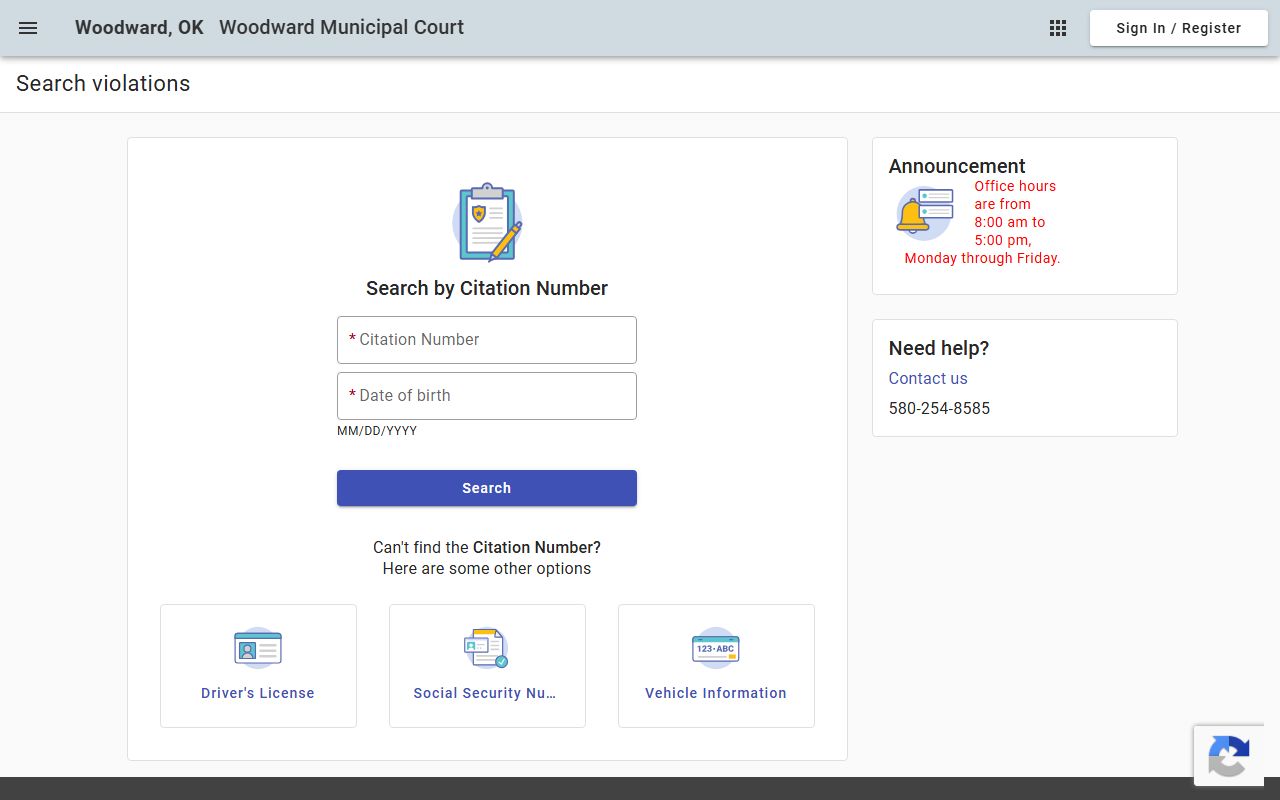
A search returns the citation, the court date, the fine status, and any warrant tied to the charge. Missing a municipal hearing has consequences. If a fine is not paid before the court date and the person does not appear, a warrant is issued. The official city FAQ says a person can then pay at the Court Clerk or surrender to the Woodward Police Department to clear it.
Charges vs. Convictions in Woodward County
Being charged is not the same as being convicted. A charge is an accusation. A conviction is the result after a plea or a verdict. A Woodward County record may show a filed charge that was later dropped, dismissed, or never proven. Reading a charge as a conviction is a common and serious mistake.
| Charge | Conviction | |
|---|---|---|
| Stage | Accusation | Verdict or plea |
| Burden of Proof | Probable cause | Beyond a reasonable doubt |
| Case Status | Still open | Final guilt established |
| Public Record | Yes | Yes |
Statewide Charge and Criminal History Lookups
Some charges follow a person beyond the county. Once a defendant is sentenced to state custody or supervision, the case rolls into statewide systems. Two official Oklahoma tools track that stage. Neither one replaces the District Court docket, yet both help locate a person after a county case ends.
- Oklahoma DOC Offender Lookup: the statewide search for sentenced inmates and supervised offenders.
- Oklahoma VINE: custody status and criminal-case notifications.
- Woodward County Court Clerk: the office of record for certified copies and charge verification.
The Department of Corrections warns that its data may be abbreviated and is not a full explanation of an offense or sentence. For an exact charge or disposition, the Court Clerk record controls.
Sealed vs. Expunged Records
Some charge records can be hidden or cleared. Oklahoma law lets eligible criminal records be sealed or expunged through a court process. A person files in the District Court where the case occurred, gives notice under 22 O.S. Sections 18 and 19, and asks the judge for an order. Sealing and expungement are not the same thing. The Woodward County Court Clerk is the filing office for these district-court petitions.
| Sealed | Expunged | |
|---|---|---|
| Visibility | Hidden from public view | Treated as if it never existed |
| Law Enforcement | Limited access | Very limited access |
| Eligibility | Court order on a qualifying case | Court order under a qualifying category |
Background Checks and Court Charge Records
A casual docket search is not the same as a formal background check. Looking up a Woodward County charge on a public portal is fine for general information. A regulated background check for hiring, housing, or credit follows the federal Fair Credit Reporting Act and uses a licensed agency. The two serve different purposes, and the rules that govern them differ.
Important: This site is not a consumer reporting agency under the Fair Credit Reporting Act, and its records may not be used to decide employment, housing, or credit.
Restricted Charge Records in Woodward County
Not every charge record is open to the public. Oklahoma law shields certain categories, and the court redacts personal details from public filings. The Oklahoma Open Records Act keeps most court records open, but it does not reach protected material.
- Juvenile charges: confidential or restricted, with access limited to parties, agencies, or court order.
- Sealed or expunged charges: removed from public view after a qualifying court order.
- Personal identifiers: Social Security numbers, dates of birth, and minor names are redacted under court rules.
- Mental health and treatment-court matters: sensitive and often confidential.
When a record is not visible online, the path forward is the Court Clerk. For booking and custody questions, the Sheriff and jail handle requests by phone, subject to open-record limits.
Note: Personal identifiers, juvenile material, and sealed charges are withheld from public dockets even when the rest of a case file stays open.