
Criminal Court Records in Woodward County
A criminal court record is the case file the court clerk opens once a prosecutor files charges. It is more than a single charge. The file gathers every document and event in one place, so it shows the charge as filed, the bond, each hearing, the plea, the verdict or agreement, and the sentence. In Woodward County, the Court Clerk keeps these files at the courthouse and lets the public read most of them. The Woodward County clerk also issues certified copies and pulls older paper files that never reach the online docket.
Felony cases and most state misdemeanor cases belong to the Woodward County District Court. This is Oklahoma's main trial court, and it handles the serious criminal matters for Woodward County. City of Woodward citations and ordinance cases run through the separate Woodward Municipal Court instead. The charge itself, with its count, statute, and prosecutor, is detailed on the Woodward County court charge records page, while the wider set of civil and family files appears in the broader Woodward County court records.
How to Search Woodward County Criminal Court Records
Two free state portals carry Woodward County District Court dockets. On Demand Court Records, known as ODCR, lists Woodward County as a participating district court and is the main practical search path for criminal cases. The Oklahoma State Courts Network, OSCN, is the statewide judiciary system and offers a case-number lookup plus daily docket reports. Both let you search Woodward County criminal felony and misdemeanor proceedings at no cost.
- Open ODCR or OSCN and choose Woodward County District Court from the court list.
- Search by defendant name in Last, First order, or enter a known case number.
- Narrow the results by case type, such as criminal felony or misdemeanor, and by filing date.
- Open the case to read the docket entries, charges, plea, disposition, and sentence.
- Ask the Woodward County Court Clerk for a certified copy or a document image not posted online.
Case numbers follow an Oklahoma format that names the type, year, and sequence, such as CF-2026-00001 for a felony or a CM number for a misdemeanor. Public users see the Woodward County docket free, yet scanned document images often sit behind the clerk's counter or paid access. The ODCR pricing page notes that District Court image access is limited to active members of the state bar, so most readers work from the docket and request copies from the clerk.
Stages of a Woodward County Criminal Case
A Woodward County criminal case moves through set stages, and each one leaves a mark in the record. The District Attorney for Woodward, Alfalfa, Dewey, Major, and Woods Counties files the charge, and from there the docket grows as the case advances. Reading the stages in order helps you see where a case stands and what comes next.
Case flow: Charges Filed › Arraignment › Pretrial / Motions › Plea or Trial › Disposition › Sentencing
| Stage | What Happens |
|---|---|
| Arraignment | The first court hearing, where the defendant hears the charge and enters a plea. Bond terms often appear here. |
| Pretrial / Motions | Lawyers file motions, exchange evidence, and set hearings. The docket fills with orders and continuances. |
| Plea or Trial | The case ends in a plea agreement or goes to trial before a judge or jury for a verdict. |
| Sentencing | After a guilty plea or verdict, the judge imposes a sentence and sets fines, costs, and any probation. |
Bonds, failure-to-appear notes, and bench warrants can show up at any stage. A missed hearing in a Woodward County case may trigger a bench warrant, which the docket logs alongside the bond entry.
What a Woodward County Criminal Court Record Shows
A Woodward County criminal case file is built from labeled fields and a running list of docket entries. The header names the court, the case number, and the case type. Party fields list the State of Oklahoma against the defendant, plus the prosecutor and defense counsel. Charge fields give the count, the offense description, and the statute. Docket entries then log the filing, hearings, bond, plea, disposition, and any fines or restitution.
| Field | What It Shows |
|---|---|
| Case Number | The type-year-sequence code, such as CF for a felony or CM for a misdemeanor, that identifies the file. |
| Defendant | The person charged, listed against the State of Oklahoma as the opposing party. |
| Charges | Each count with its offense description and statute citation, as filed by the District Attorney. |
| Plea | The defendant's formal answer to the charge, such as guilty, not guilty, or no contest. |
| Disposition | The final outcome of each count, such as convicted, dismissed, or acquitted. |
| Sentence | The penalty after conviction, including jail or prison time, probation, fines, and court costs. |
Personal identifiers are meant to be left out or redacted. Under Oklahoma court rules, Social Security numbers, account numbers, and the names of minors should not appear in public filings.
Woodward County Charges vs. Convictions
A charge is not a conviction. In a Woodward County case, being charged means the prosecutor has accused someone and asked the court to proceed. A conviction means a judge or jury found the person guilty, or the person pled guilty. A Woodward County criminal court record can show charges that were later dropped, dismissed, or that ended in acquittal, so the disposition line matters as much as the charge line.
| Charge | Conviction | |
|---|---|---|
| Stage | Accusation | Verdict or plea |
| Burden of Proof | Probable cause | Beyond reasonable doubt |
| Public Record | Yes | Yes |
Always read the full Woodward County docket before drawing a conclusion. A charge near the top of a file may have been reduced or dismissed by the time the case closed.
Reading Woodward County Dispositions and Sentences
The disposition is the final outcome of a charge in the Woodward County case file. Common entries include guilty, not guilty, dismissed, and a no-contest plea, sometimes shown as nolo. A case may also end in a deferred outcome, where the court holds judgment while the defendant meets set terms. If the terms are met, the charge can be dismissed; if not, the court may enter the conviction.
The sentence sits next to the disposition once a conviction lands. It can list jail or prison time, a suspended term, probation, fines, court costs, and restitution to a victim. The docket may also track payment plans and any warrant issued for failure to pay. A dismissed-with-prejudice note means the charge generally cannot be refiled, while dismissed-without-prejudice leaves the door open. Each Woodward County sentence line is read against the matching charge to see how the case truly closed.
Sentenced Offenders in Oklahoma DOC Records
When a Woodward County criminal case ends in a prison sentence, the offender moves from county custody to the Oklahoma Department of Corrections. The state agency keeps its own record of sentenced inmates and supervised offenders. The Oklahoma DOC offender lookup lets the public search those records by name.
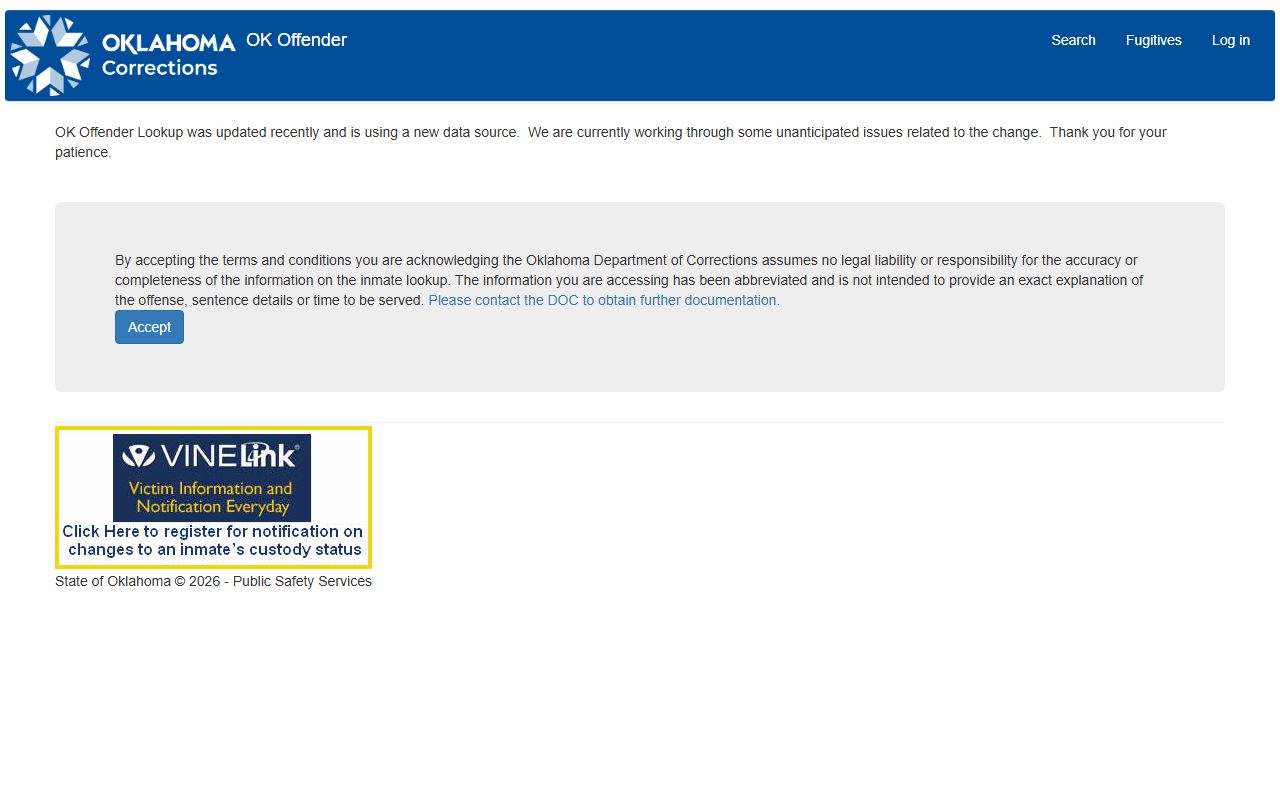
This statewide tool fills a gap the county system does not cover, since it follows a person after sentencing. The DOC notes that lookup data may be abbreviated and is not an exact statement of the offense, sentence, or time to be served, so the court clerk's file stays the better source for case detail.
Custody and Case Notifications
Victims, witnesses, and the public can track custody and Woodward County court events without checking the docket every day. Oklahoma uses a free service for these alerts. The Oklahoma VINE system sends notices about custody status and criminal-case activity.

Registering through VINE means an alert can reach you by phone or email when a status changes. It works alongside the Woodward County criminal court records search, giving live updates that a static Woodward County docket page does not provide on its own.
Sealed and Expunged Woodward County Records
Oklahoma lets some people limit public access to an eligible Woodward County criminal record. Sealing hides the file from public view, while expungement goes further and treats the record as though it never existed. Both require a court petition and an order from a judge, and both run through the District Court where the case was heard.
| Sealed | Expunged | |
|---|---|---|
| Visibility | Hidden from public | Destroyed / treated as never existed |
| Law Enforcement | Limited access | Very limited |
| Eligibility | Set by 22 O.S. § 18 and § 19 on a qualifying petition | Granted by court order under the same expungement statutes |
The path is set out in the Oklahoma expungement statutes. You can read the current text of the law on the OSCN statute page for 22 O.S. § 19.
To clear or seal a record, a person files in the district court where the case happened, gives the required notice, and asks the judge for an order under the applicable statute. The petition should identify the case, the charge, and the disposition, and explain the eligibility basis. If the judge grants it, the order directs the Court Clerk, the Sheriff, and other agencies to seal or restrict the file as the statute allows.
Public Access to Woodward County Criminal Court Records
Most Woodward County criminal case files are open to the public. The state's open-records law treats government records as available for inspection and copying during business hours unless another law makes them confidential. That framework is why ODCR and OSCN can post Woodward County District Court dockets for anyone to read. The Court Clerk remains the official source when a reader needs a certified copy or wants to verify a disposition.
Key Statutes:
Oklahoma Code § 51-24A.1 - names the Oklahoma Open Records Act, the state's public-records law.
Oklahoma Code § 51-24A.5 - makes public-body records open for inspection unless a law marks them confidential.
Rule 31, Rules for District Courts - guides how personal identifiers are handled in court filings.
Federal Criminal Cases Are Separate
Not every crime in Woodward County is a state case. Federal offenses are charged and tried in federal court, and Woodward County sits in the Western District of Oklahoma. Those cases never appear in the county clerk's files. The U.S. Attorney for the Western District of Oklahoma is the charging authority for federal prosecutions.
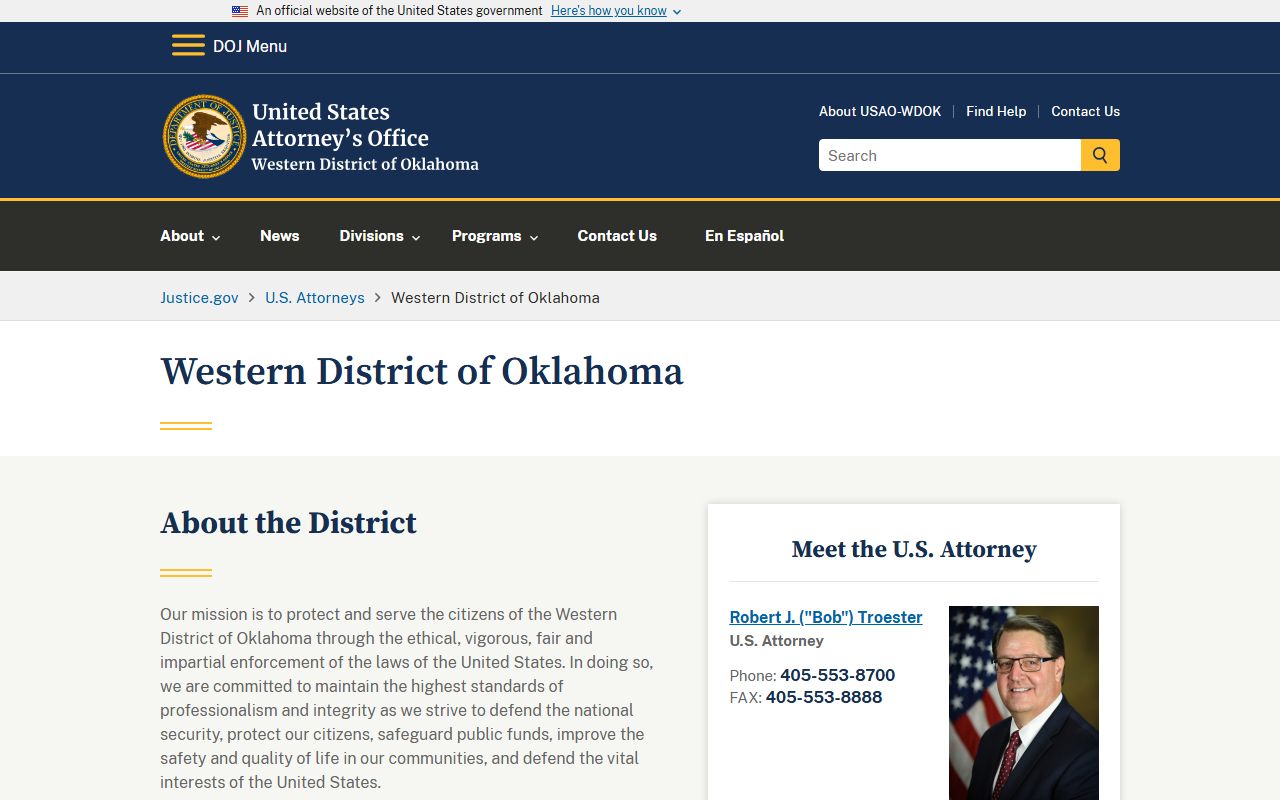
Federal records live in the federal court system, not on ODCR or OSCN. If a case involves a federal charge rather than a state one, the search moves to the federal courts and prosecutors that cover western Oklahoma.
Background Check Considerations
A Woodward County docket search is fine for personal curiosity or to follow a case. It is not the same as a regulated background check. Decisions about hiring, housing, credit, or insurance fall under the federal Fair Credit Reporting Act and must use a compliant consumer reporting agency. A casual lookup on a public portal does not meet that standard, and it may miss sealed or corrected entries.
Important: This site is not a consumer reporting agency under the FCRA, and its information cannot be used for employment, tenant, credit, or insurance screening.
Restricted Woodward County Criminal Court Records
Open access has limits. Several kinds of Woodward County criminal court records are withheld or shielded by Oklahoma law, even when a case touches the District Court. Juvenile cases are confidential under the state juvenile code, and access is generally limited to parties, attorneys, agencies, or those with a court order. Sealed and expunged files leave public view only after a qualifying petition and order.
- Juvenile cases, confidential under the Oklahoma juvenile code.
- Sealed or expunged criminal files removed by court order.
- Mental health and treatment-court matters, which may be partly sealed.
- Personal identifiers such as Social Security and account numbers, redacted by rule.
When a record is not visible online, the Woodward County Court Clerk is the office to ask. The clerk can confirm whether a file exists, whether it is restricted, and how to request a copy. For questions about a state prosecution, the District Attorney's office is the charging authority and can explain the criminal process.
Note: Sealed and expunged cases are removed from public search on purpose, so an empty result does not always mean a person was never charged.